June 10, 2010 (Day 23)
It's five o'clock in the morning. Time to wake up. We're leaving in 30 minutes.
Yes, morning has finally arrived!
We boarded the jeep and made our way to witness the sunrise amongst the geysers and hot springs.
It was time for breakfast and the other jeep wasn't behind us. Perhaps, they stayed back at the geysers a bit longer. Maybe the Australian girls were still in bed at the lodge. Maybe the jeep got stuck. These were all theories that passed through our minds as we waited for our English-speaking tour guide and cook to arrive with the other jeep. Our Spanish-speaking driver did not have a radio to communicate with the other jeep, and was just as clueless as the rest of us. We had to be at the Chilean border by 9:45am to catch our bus. Time was quickly ticking away. Around 8am, our cook arrived and informed us that the other jeep broke down by the geysers. She hitched a ride to the cabin to prepare our breakfast while our guide and that jeep's tour group stayed behind to attempt to fix the jeep. Luckily, we weren't in that jeep. We rushed through breakfast and continued on our journey towards the border. Our driver was flooring it. Even though the jeep's speedometer did not work, it was evident that were driving much faster than the posted speed limit. I still don't know why they have speed limit signs there but perhaps it just meant that we were slowly approaching civilization again.
We arrived at Laguna Verde, where the water is a hint of green in colour. Once again, definitely not as vibrant as in all the photographs, but beautiful nonetheless.
We then headed off to our final destination, the Bolivian-Chilean border, where we waited by a little building until our shuttle bus arrived.
Now for a quick review of Andes Salt Expeditions Tour Operator:
On the plus side, we arrived at our final destination safely and on time without any incidents. That being said, I found that our tour wasn't very time efficient, and from what I could see (and what do I know), our entire tour could have easily been completed over a 2 day / 1 night period. By the time our tour started, it was already past noon on the first day. We could have easily started earlier and traveled further on our first day (or stayed longer at the two main stops to take even more funny pictures or further explore Fish Island, if the location of our lodges was the reason for our late start). The second day definitely ended too quickly as we were at our lodge by 3pm with nothing to see or do for the rest of the day. We could have easily continued onto the geysers and hot springs for a late afternoon dip before heading back to the lodge. I assume the location of the lodges was again the issue but since they were so basic, why not build new lodges in more convenient locations. But anyways, this is probably an issue common to all the operators. As for our English-speaking tour guide, he was in the other jeep so we really didn't benefit from any of his services outside the few comments he made at the stops. He also did not hang out with us at the lodges in the evenings. Luckily, we didn't pay too much extra for his services because we ended up relying mostly on the explanations our Australian friends received from their personal English-speaking Peruvian tour guide. As for our driver, he was a bit adventurous, taking the road less traveled in many instances, which was more than fine with me, yet he wasn't too friendly or considerate. He was never drunk and did get us to our destination safely so that should be recognized as we heard tourists talking about a drunk driver (from another tour operator) who apparently flipped a jeep the day before our trip began. You definitely don't want that to happen when you're in the middle of nowhere in a salt flat or desert. As for the jeeps, ours was ok, despite the band-aid on the passenger door ;) These jeeps take a lot of abuse under a variety of conditions so it is to be expected that they wouldn't be in the greatest condition but it should be noted that the other jeep had mechanical problems that disrupted the tour. All in all, Andes Salt Expeditions showed us the sites as promised so while they might not be the best organized tour operators, they managed to get the job done for us.
Now, back to the day's events. We crossed the border into Chile in what can only be described as one of those modern airport shuttle buses you see in North America,
and made our way down a paved downhill highway to San Pedro de Atacama, where we got our passports stamped and belongings thoroughly examined by hand. The officer checking my backpack noticed my first aid supplies, and asked me if I'm a doctor. I giggled under my breath and said no. Apparently, if you have a first aid kit in Chile, you're automatically considered to be a doctor!
Welcome to Chile! Home of the $5000 pitcher of beer!
The menu prices are, of course, priced in Chilean Pesos, but besides the extra zeros involved in the currency conversion, things were still considerably more expensive than in either Peru or Bolivia.
San Pedro de Atacama is a quiet little town, once again geared towards tourists, as it acts as the Chilean starting point for a lot of eco-tours and outdoor expeditions. Unfortunately, we didn't have more time to explore the local natural attractions as we were soon on our way on our next overnight bus trip to Arica, Chile.
Showing posts with label Bolivia. Show all posts
Sleepless in Bolivia
June 9, 2010 (Day 22)
Oh, what a night!
Besides observing the spectacular star-lit sky in the middle of a Bolivian desert, there's nothing like spending a night with a completely drunk stranger as your room mate, who passed out in your shared bedroom in a freezing cold salt hotel. I have never heard anyone snore so loud! So there I was in my bed, trying to fall asleep all night long while this guy snored pretty much the whole night away. And when he wasn't snoring, he wasn't breathing! Oh yes, he finally stopped snoring. Oh wait, is he breathing? Hmm, it doesn't sound like he's breathing? No, he must be breathing really quietly. Hmm, that's a pretty long time without hearing any breathing? Should I get up and check? Ummm... I just can't hear him breathing.. oh wait, maybe I should check.. Nah... Is he dead? Ok, I'm getting up.... and then the snoring begins again. Sigh, that's a relief. Oh wait, is it really? I can't sleep! And I can't breath! And random body parts are becoming numb. This is not good...
So there I was, wide awake all night long, tossing around in bed, under a couple of alpaca blankets, in multiple layers of clothing, trying to maintain body circulation. All while I made sure my roommate didn't die on my watch... so frustrating...
Morning finally came with breakfast at 6... let's just say that my roommate didn't take the wake up call very well... with verbal threats of slicing our guide's neck wide open with a butter knife, and his violent tossing of his own belongings out of the room, it was time to grab my stuff and get out of there before it got any worse!
After breakfast, we departed for Laguna Colorada, passing other lagoons on the way as we passed through the Siloli Desert. Our route reached an elevation of approximately 5,000 metres above sea level as we passed through ever-changing landscapes that were simply spectacular.
At about 2pm, we reached Laguna Colorada, where we appreciated its red colouration, which is derived from algae and plankton that thrive on its minerals. It was a very nice sight to see, especially with the flamingos strutting their stuff in the cool water, along with the alpacas, llamas, and vicunas grazing along the shoreline.
That being said, I was honestly a bit disappointed as the red colouration of the water wasn't as vibrant as in all the photos we saw. I guess I was a victim of Photoshop.
We then continued to our salt lodge, where we arrived around 3pm, and had nothing to do for the rest of the day but keep each company and staying warm as we nibbled away on the crackers they provided. I'm not sure why they were in such a rush to get us here.
This night was going to be the coldest night of the trip, and it definitely measured up to those expectations. Slowly building up layers of clothing as the afternoon and evening progressed, it became progressively harder to stay warm, especially after dinner, and by 8pm, everyone was in bed. Not only were we in basic salt lodge accommodations at high altitude sharing a bedroom with all our fellow tour group members, but we were also sleeping on a thin mattress that was the only thing separating us from the concrete slabs we were laying on, and it was quite a long walk through a drafty hallway to the washroom. Definitely basic sleeping quarters.
This was without a doubt the most difficult night of the trip for me. After putting on all my layers, getting into my sleeping bag, and covering myself with the blankets, I still found it cold (even with my toque). I somehow manged to fall asleep, probably from the lack of sleep the night before, but then I woke up around 11:30pm, only to find myself extremely hot. I overdressed. I started shedding layers and then found it too cold. My favourite new buddy was snoring again, and I couldn't fall asleep. I walked around in the hallway a bit and took in the breathtaking night sky, and headed back to bed. I think I fell asleep for a while and then woke up again, breathless. Oh God, I thought I was dying. I was taking deep breaths and it wasn't helping. To top it off, my snoring neighbour was breathing very heavily and quickly so I think that I must have been subconsciously thinking that I had to breath that quickly as well, which I couldn't, and I started panicking. Definitely not good. I took an altitude pill but those don't work right away. But eventually, I was able to settle down. Morning couldn't come soon enough.
The Blinding Salar de Uyuni
June 8, 2010 (Day 21)
Like I mentioned earlier, the only reason we went to Uyuni was because that's the starting point for tours of the Salar de Uyuni, the world's largest salt flat. There are tonnes of tour operators offering pretty much the same tour itinerary and price so even though there isn't much to do in Uyuni, comparing countless operators is basically pointless because they will all promise you the same thing. We selected Andes Salt Expeditions Tour Operator because they were recommended by some fellow tourists we talked to earlier on our trip and they also offered an English-speaking guide for a minimal extra cost.
The tour was scheduled to leave at 10:30am but by the time the tour operator figured out (after asking us countless times) who was going in which jeep, who was vegetarian, who needed a sleeping bag, who was coming back to Uyuni (vs. Chile), who was on the 2-day trip (vs. the 3-day trip), we did not actually depart until after 11:00am.
We were on the 3-day trip that would take us to the Chilean border and save us another visit to Uyuni and a long bus ride to our next destination. Hence, we had to get our passports stamped with post-dated Bolivian exit stamps at a little office, just down the street from the tour operator, without any questions asked. The officials did this many times before and it showed.
Here is a map of our Salar de Uyuni journey over the next three days.
So we got into our jeep along with a couple of Australian women, their Peruvian English-speaking guide, an American, and our driver, and we were on our way on our tour of Salar de Uyuni Another jeep full of tourists, the group's cook, and our English-speaking guide were also involved in our tour group.
Our first stop was just outside the outskirts of town, where you can find the place where a series of nineteenth and early 20th century steam engines, locomotives, and rail cars have gone to die at the train cemetery. Had I known that the graveyard had been so close to town, I would have journeyed over here yesterday when there was absolutely nothing to do!
After about 20 minutes of climbing onto the trains like a little kid in a playground, and snapping a few photos, it was time to get back into the jeep, and head back into town to pick our food. I'm not sure why they couldn't have done this before picking us up for the tour but anyways, just go with the flow, Mike. After a 5-10 minutes wait to load the jeep, we then proceeded to a garage to have the air pressure checked on the jeep tires. Once that was done, it was time to pull out the big sunglasses as we were finally on our way to salt flats!
We arrived in Colchanilies, which lies beside the Salar de Uyuni, and is the home of the Cooperative Rosario where we observed the methods of salt extraction from the Salar and its preparation for national consumption.
After our llama-steak lunch at a little restaurant made out of salt,
and taking a number of "funny pictures,"
we headed off to Isla Pescada which is located in the centre of the Salar (about 100 km from Uyuni). Surrounded by the blinding white salt flat, we hiked the trail that weaves its way around the spectacular “island“ that is covered in trichocerus cacti and home to a number of viscachas that look like huge rabbits.
If you are curious about the feel of the salt flat, I can say that it has a pretty unique feeling. It looks a bit like icy snow, crunchy and hard, but definitely a bit different. And it obviously, tastes like salt!
Just as the sun was setting,
we arrived at a salt hotel, just off the Salar. Picture the ice hotel but made out of salt and not as luxurious, but just as unique. After settling into our rooms for the evening,
we headed to the dining room to talk with our fellow travelers and enjoy dinner as a group of kids sung and played musical instruments for us. After dinner, the generator was about to go out and most people headed back to their rooms, but a few of us stayed behind, and treated the kids to the plentiful leftovers. At first, some of the kids were reluctant or shy to accept our offering but considering we, unfortunately, did not have anything else to offer them, we insisted that they join us at the table and eat the untouched food left behind. I remember there was one boy who appeared to be too scared to join us, perhaps he was afraid that he would get in trouble, but I finally convinced him to join us by treating him just like one of us by calling him “Amigo“. It seemed like that was the magic word that convinced him it was ok to eat with us. That was a very moving moment for me as the kids were apparently really hungry as they tried eating as much as possible as quickly as they could, and it really put things into perspective as to how lucky we really have it.
The lights turned off soon thereafter and the kids were shooed off by the kitchen staff as they cleared off the table, and we were left to share our travel stories in the candlelight. As the candle got shorter, it was time to head to our rooms. It was the end of a memorable day and just the beginning of a memorable night...
Like I mentioned earlier, the only reason we went to Uyuni was because that's the starting point for tours of the Salar de Uyuni, the world's largest salt flat. There are tonnes of tour operators offering pretty much the same tour itinerary and price so even though there isn't much to do in Uyuni, comparing countless operators is basically pointless because they will all promise you the same thing. We selected Andes Salt Expeditions Tour Operator because they were recommended by some fellow tourists we talked to earlier on our trip and they also offered an English-speaking guide for a minimal extra cost.
The tour was scheduled to leave at 10:30am but by the time the tour operator figured out (after asking us countless times) who was going in which jeep, who was vegetarian, who needed a sleeping bag, who was coming back to Uyuni (vs. Chile), who was on the 2-day trip (vs. the 3-day trip), we did not actually depart until after 11:00am.
We were on the 3-day trip that would take us to the Chilean border and save us another visit to Uyuni and a long bus ride to our next destination. Hence, we had to get our passports stamped with post-dated Bolivian exit stamps at a little office, just down the street from the tour operator, without any questions asked. The officials did this many times before and it showed.
Here is a map of our Salar de Uyuni journey over the next three days.
Our first stop was just outside the outskirts of town, where you can find the place where a series of nineteenth and early 20th century steam engines, locomotives, and rail cars have gone to die at the train cemetery. Had I known that the graveyard had been so close to town, I would have journeyed over here yesterday when there was absolutely nothing to do!
After about 20 minutes of climbing onto the trains like a little kid in a playground, and snapping a few photos, it was time to get back into the jeep, and head back into town to pick our food. I'm not sure why they couldn't have done this before picking us up for the tour but anyways, just go with the flow, Mike. After a 5-10 minutes wait to load the jeep, we then proceeded to a garage to have the air pressure checked on the jeep tires. Once that was done, it was time to pull out the big sunglasses as we were finally on our way to salt flats!
We arrived in Colchanilies, which lies beside the Salar de Uyuni, and is the home of the Cooperative Rosario where we observed the methods of salt extraction from the Salar and its preparation for national consumption.
After our llama-steak lunch at a little restaurant made out of salt,
and taking a number of "funny pictures,"
we headed off to Isla Pescada which is located in the centre of the Salar (about 100 km from Uyuni). Surrounded by the blinding white salt flat, we hiked the trail that weaves its way around the spectacular “island“ that is covered in trichocerus cacti and home to a number of viscachas that look like huge rabbits.
If you are curious about the feel of the salt flat, I can say that it has a pretty unique feeling. It looks a bit like icy snow, crunchy and hard, but definitely a bit different. And it obviously, tastes like salt!
Just as the sun was setting,
we arrived at a salt hotel, just off the Salar. Picture the ice hotel but made out of salt and not as luxurious, but just as unique. After settling into our rooms for the evening,
we headed to the dining room to talk with our fellow travelers and enjoy dinner as a group of kids sung and played musical instruments for us. After dinner, the generator was about to go out and most people headed back to their rooms, but a few of us stayed behind, and treated the kids to the plentiful leftovers. At first, some of the kids were reluctant or shy to accept our offering but considering we, unfortunately, did not have anything else to offer them, we insisted that they join us at the table and eat the untouched food left behind. I remember there was one boy who appeared to be too scared to join us, perhaps he was afraid that he would get in trouble, but I finally convinced him to join us by treating him just like one of us by calling him “Amigo“. It seemed like that was the magic word that convinced him it was ok to eat with us. That was a very moving moment for me as the kids were apparently really hungry as they tried eating as much as possible as quickly as they could, and it really put things into perspective as to how lucky we really have it.
The lights turned off soon thereafter and the kids were shooed off by the kitchen staff as they cleared off the table, and we were left to share our travel stories in the candlelight. As the candle got shorter, it was time to head to our rooms. It was the end of a memorable day and just the beginning of a memorable night...
A Little Town Called Uyuni
June 7, 2010 (Day 20)
After boarding our "heated" tourist bus in La Paz the previous evening, we woke up in the morning, freezing cold, even under our blankets. After scraping the frost off the bus window, I figured that we must have reached our destination, Uyuni, slightly ahead of the scheduled arrival time. I guess when they advertise a bus as having heating and cooling, they don't necessarily mean actual heat or air conditioning, but blankets and the cool night air. But enough about that, we stepped out of the bus to be greeted by a bunch of people soliciting business for their tours and hostels. It's not even 6:30am, barely light outside, we're a step off the bus in the freezing (and I mean, freezing cold), and they want us to sign up for a tour right there and then?!? Please! Get out of my way! Thank you very much! Let me grab our bags off the bus before they disappear!
We were expecting it to be cold but not this cold! The frigid cold temperatures caught us a bit off-guard and we weren't really prepared for it as we didn't reserve a place to stay, thinking it was a small town and could find a place within a few minutes. But in fact, the city was sprawled out and the bus dropped us off in a non-commercial area so we, smartly or foolishly, accepted the first hostel offer we received and we were getting into a stranger's jeep to get to it. Hmm, there's two of them and three of us. Certainly, we can take them on if they were planning something foolish with us!
So we arrived at Hostal Marith in downtown Uyuni
and entered the lobby
where we noticed the locked-up rolls of toilet paper
and then we walked across the courtyard
to our room (sorry about the mess but we're backpackers after all)
and yes, that is a styrofoam ceiling with styrofoam crown molding. We were certainly living it up in style in Uyuni!
And well, I guess I forgot to take a photo of the washroom but I'll try to illustrate it to you in words. Picture a regular washroom with a shower, toilet, sink, and a floor drain in the middle but there's no barrier separating the shower from the rest of the room. So when you dared to turn on the shower with its copper coil heating element, not only did you have to worry if you'd get electrocuted but everything in the room got wet as well. Nevertheless, Hostal Marith protected us from the elements that night so I won't complain.
Well besides sleeping, there really isn't much to do in Uyuni. Probably the biggest attraction in town would be the big slide in the local park, and yes, we tested it out. The goods news is it became considerably warmer by 10 am.
Other than that, there really isn't much to see or do besides walk around town, watch the locals congregate around the propane tank delivery truck, eat at a restaurant (they all appeared to sell the same type of food catered to tourists - i.e. pizza), exchange some money, get your hair done at a salon, watch the military do their thing,
and oh yeah, the only reason why we were here, to book a Salar de Uyuni tour with one of the local tour operators.
After boarding our "heated" tourist bus in La Paz the previous evening, we woke up in the morning, freezing cold, even under our blankets. After scraping the frost off the bus window, I figured that we must have reached our destination, Uyuni, slightly ahead of the scheduled arrival time. I guess when they advertise a bus as having heating and cooling, they don't necessarily mean actual heat or air conditioning, but blankets and the cool night air. But enough about that, we stepped out of the bus to be greeted by a bunch of people soliciting business for their tours and hostels. It's not even 6:30am, barely light outside, we're a step off the bus in the freezing (and I mean, freezing cold), and they want us to sign up for a tour right there and then?!? Please! Get out of my way! Thank you very much! Let me grab our bags off the bus before they disappear!
We were expecting it to be cold but not this cold! The frigid cold temperatures caught us a bit off-guard and we weren't really prepared for it as we didn't reserve a place to stay, thinking it was a small town and could find a place within a few minutes. But in fact, the city was sprawled out and the bus dropped us off in a non-commercial area so we, smartly or foolishly, accepted the first hostel offer we received and we were getting into a stranger's jeep to get to it. Hmm, there's two of them and three of us. Certainly, we can take them on if they were planning something foolish with us!
So we arrived at Hostal Marith in downtown Uyuni
and entered the lobby
where we noticed the locked-up rolls of toilet paper
and then we walked across the courtyard
to our room (sorry about the mess but we're backpackers after all)
and yes, that is a styrofoam ceiling with styrofoam crown molding. We were certainly living it up in style in Uyuni!
And well, I guess I forgot to take a photo of the washroom but I'll try to illustrate it to you in words. Picture a regular washroom with a shower, toilet, sink, and a floor drain in the middle but there's no barrier separating the shower from the rest of the room. So when you dared to turn on the shower with its copper coil heating element, not only did you have to worry if you'd get electrocuted but everything in the room got wet as well. Nevertheless, Hostal Marith protected us from the elements that night so I won't complain.
Well besides sleeping, there really isn't much to do in Uyuni. Probably the biggest attraction in town would be the big slide in the local park, and yes, we tested it out. The goods news is it became considerably warmer by 10 am.
Other than that, there really isn't much to see or do besides walk around town, watch the locals congregate around the propane tank delivery truck, eat at a restaurant (they all appeared to sell the same type of food catered to tourists - i.e. pizza), exchange some money, get your hair done at a salon, watch the military do their thing,
and oh yeah, the only reason why we were here, to book a Salar de Uyuni tour with one of the local tour operators.
Professional Fútbol in La Paz
June 6, 2010 (Day 19)
Our day started off with a walk around La Paz and a visit to the Witches' Market. The setting was not quite as I envisioned it but if you are ever looking for alpaca embryos, animal parts, mysterious concoctions, good luck charms, and other sorcery items, then this would be the place to start. The storekeepers, probably experienced in tourists just looking and not buying, were not eager to sell us anything, and quite frankly, I was not in the mood to get cursed, so we continued on our way through town.
At the top of our "nice to do" list was the opportunity to watch a soccer game. South Americans are passionate about their fútbol so if there was a chance to catch a game on our trip, we were going to jump on that chance and so we did.
Bolivar vs. Wilstermann
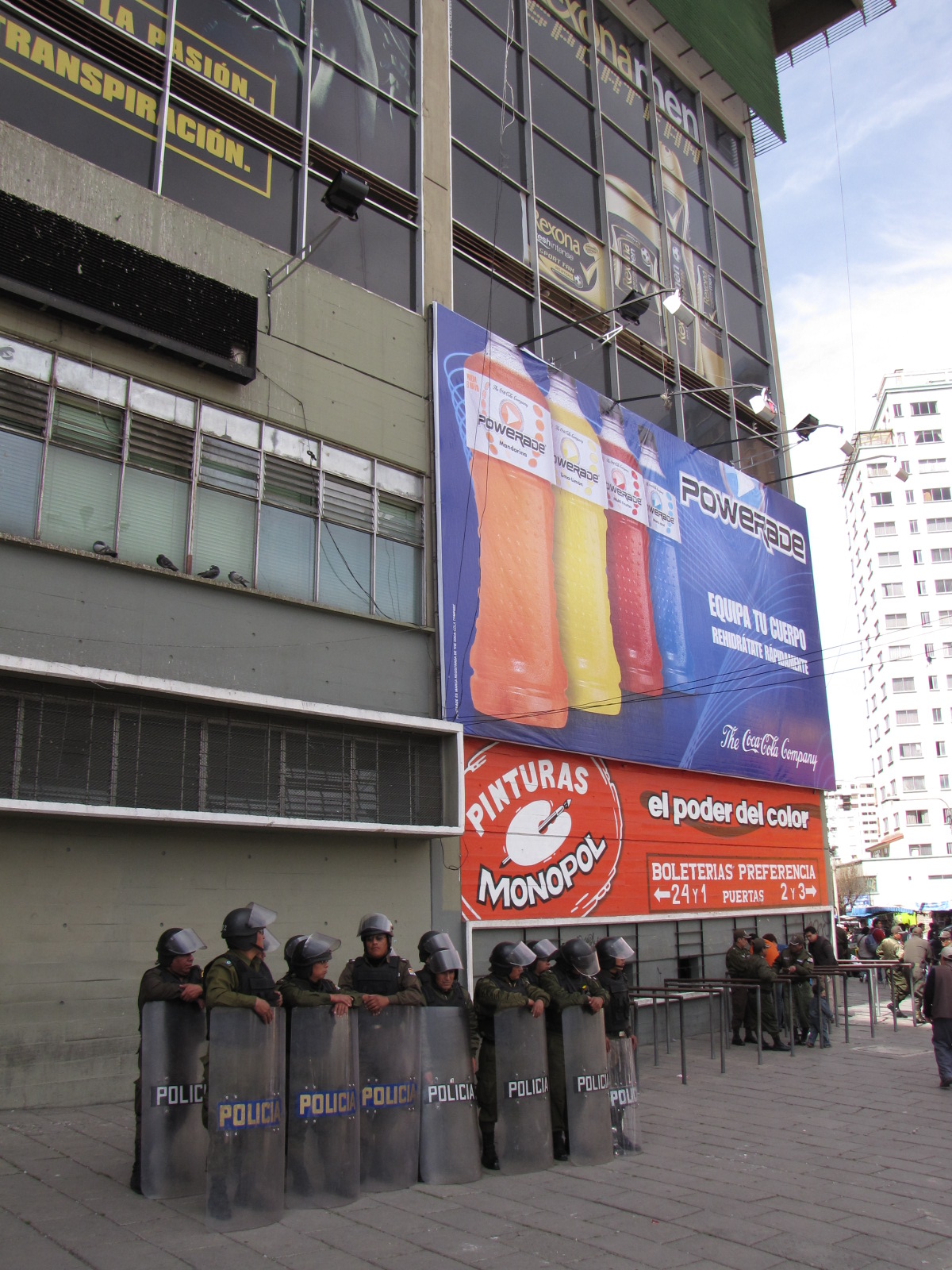
The riot squad is slowly growing in numbers, styrofoam seat cushions are selling like hotcakes, walk-up tickets sales are brisk, and the three Canadian soccer fans are all decked out in Bolivar gear. Let's hope our tickets are in the right section!
We entered the stadium and our daypacks were checked. Everything was ok but we had to empty our water bottles. Ok, no problem. We headed our section and picked some good seats, and looked at the endzone, only to see the visiting team's fans running around with flares, and the game hasn't even started yet.
The visiting team enters the pitch, and firecrackers go off in the endzone seats. Woah, hold on there! No water allowed in the stadium, but flares and firecrackers, they're ok! Even though the stadium wasn't packed to capacity, excitement was in the air, and the first (and only goal) of the game only heated the fans' passions. I think I even heard gun shots during the goal celebrations. As the game's officials headed off the pitch at half-time, they were hailed with garbage until the riot squad moved in to provide some protection. Then in the second half, a dog somehow managed to get on the field, and walk around while play continued in the same zone.
Eventually, the dog decided it was too hot out there on the field and left at its own discretion across the field. No special attention was given to the dog as if it were a regular occurence, and perhaps it was. Next thing you know, the dog right next to me watching the game from the stands!
As the game entered its final moments, we headed for the exits just to encounter mobs of people entering the stadium. It looked like they just let anyone come in for the final few minutes of the game. We caught a cab and headed back to the hostal to pick up our packs and headed to the bus station for our 12-hour overnight bus trip to Uyuni.
Our day started off with a walk around La Paz and a visit to the Witches' Market. The setting was not quite as I envisioned it but if you are ever looking for alpaca embryos, animal parts, mysterious concoctions, good luck charms, and other sorcery items, then this would be the place to start. The storekeepers, probably experienced in tourists just looking and not buying, were not eager to sell us anything, and quite frankly, I was not in the mood to get cursed, so we continued on our way through town.
At the top of our "nice to do" list was the opportunity to watch a soccer game. South Americans are passionate about their fútbol so if there was a chance to catch a game on our trip, we were going to jump on that chance and so we did.
Bolivar vs. Wilstermann
The riot squad is slowly growing in numbers, styrofoam seat cushions are selling like hotcakes, walk-up tickets sales are brisk, and the three Canadian soccer fans are all decked out in Bolivar gear. Let's hope our tickets are in the right section!
We entered the stadium and our daypacks were checked. Everything was ok but we had to empty our water bottles. Ok, no problem. We headed our section and picked some good seats, and looked at the endzone, only to see the visiting team's fans running around with flares, and the game hasn't even started yet.
The visiting team enters the pitch, and firecrackers go off in the endzone seats. Woah, hold on there! No water allowed in the stadium, but flares and firecrackers, they're ok! Even though the stadium wasn't packed to capacity, excitement was in the air, and the first (and only goal) of the game only heated the fans' passions. I think I even heard gun shots during the goal celebrations. As the game's officials headed off the pitch at half-time, they were hailed with garbage until the riot squad moved in to provide some protection. Then in the second half, a dog somehow managed to get on the field, and walk around while play continued in the same zone.
Eventually, the dog decided it was too hot out there on the field and left at its own discretion across the field. No special attention was given to the dog as if it were a regular occurence, and perhaps it was. Next thing you know, the dog right next to me watching the game from the stands!
As the game entered its final moments, we headed for the exits just to encounter mobs of people entering the stadium. It looked like they just let anyone come in for the final few minutes of the game. We caught a cab and headed back to the hostal to pick up our packs and headed to the bus station for our 12-hour overnight bus trip to Uyuni.
Mountain Biking Death Road
June 5, 2010 (Day 18)
After a few days of tranquil relaxation, it was time to step it up a notch, and mountain bike down “The World's Most Dangerous Road."
Yes, that's right, the World's Most Dangerous Road, as dubbed by the Inter-American Development Bank in 1995, and locally known as "Death Road" or "Camino de la Muerte!"
So why is it called that? Well, according to Wikipedia, the North Yungas Road is legendary for its extreme danger and an estimated 200 to 300 travellers were killed yearly along the road, and at least 18 cyclists have died on the ride since 1998.
After confidently signing up the previous evening at the Gravity Assisted Mountain Biking office in downtown La Paz (despite the employee's arm being in a cast!), Steph and I headed to Alexander's Coffee for breakfast to join up with our fellow thrill seekers. At 7:30, we hopped into the van and started our 1-hour drive to La Cumbre.
After getting decked out in the helmet and outerwear provided, we prepped our bikes, and solemnly swore that we would not be idiots today and saluted Pacha Mama with a sip of a vile alcoholic beverage that we then sprinkled on our bike tires and the ground.
After a few days of tranquil relaxation, it was time to step it up a notch, and mountain bike down “The World's Most Dangerous Road."
Yes, that's right, the World's Most Dangerous Road, as dubbed by the Inter-American Development Bank in 1995, and locally known as "Death Road" or "Camino de la Muerte!"
So why is it called that? Well, according to Wikipedia, the North Yungas Road is legendary for its extreme danger and an estimated 200 to 300 travellers were killed yearly along the road, and at least 18 cyclists have died on the ride since 1998.
After confidently signing up the previous evening at the Gravity Assisted Mountain Biking office in downtown La Paz (despite the employee's arm being in a cast!), Steph and I headed to Alexander's Coffee for breakfast to join up with our fellow thrill seekers. At 7:30, we hopped into the van and started our 1-hour drive to La Cumbre.
After getting decked out in the helmet and outerwear provided, we prepped our bikes, and solemnly swore that we would not be idiots today and saluted Pacha Mama with a sip of a vile alcoholic beverage that we then sprinkled on our bike tires and the ground.
And so it begins… the bike ride of our lives, down more than 3,600 metres, from high-altitude plains and mountain ranges down to the steaming Amazonian jungle!
We began the ride at La Cumbre (4,700m) where we had great views of a number of snow-covered peaks. From here, we descended rapidly down a twisting asphalted road (known affectionately as "The Tarmac") right next to less-than-sympathetic trucks and buses, among mountain peaks, tiny villages and of all things, a drug check-post.
This was deemed to be the easy part of the trek, yet I'd argue that it might be just as dangerous as the rest of the ride. Since the road was asphalted, you pick up speed very quickly and one tiny slip on one the many tight curves, and you'd be scrapping yourself across the road into an upcoming vehicle or down a cliff! And to top it off, as you're heading down, you suddenly hit the clouds, resulting in almost zero visibility in front of you. Now the clouds were expected to clear up as we headed down in altitude but they really didn't as it turned a bit misty as we hit the jungle, which isn't the greatest thing as you can imagine for someone like me wearing glasses! So at every stop, I'd be trying to clean off my glasses so I could actually see the road ahead of me! Yes, the nerd tried to be hardcore adventurous today, and the nerdiness really showed ;)
Then came the part our guide unapologetically said the office intentionally avoided to mention: an 8-km uphill section. It's not like it was a ridiculous uphill section at sea level, but we weren't at sea level, but several kilometres above it, and I was still trying to get over my sniffles! The uphill ride began and so did the showers but after stopping a few times to catch my breath and wipe my glasses, slowly but surely, we were back to heading downhill.
We were now officially on Death Road and you can definitely see why it would be called that as the narrow dirt road is cut into the side of a mountain with barely enough room for a single car, let alone opposing traffic.
With 1,000+ metre sheer drops off to our left and massive rock overhangs and cascading waterfalls to our right, and the occasional car coming around a blind corner, we hurtled down this winding road, passing many crosses and memorials along the way to remind us of the dangers just a few feet away.
As we neared the last quarter of the ride, the mist disappeared and we started shedding off layers of clothing as it got progressively hotter.
By the time we arrived at the bottom in Yolosa (1,100m), we were all hot, muddy, and ready for a shower so we rode down to La Senda Verde Animal Refuge to enjoy our well-deserved beer, shower, and buffet lunch. The Animal Refuge is run by volunteers from all around the world, who take care of rescued tropical animals ranging from macaws to monkeys to caimans and pretty much everything in between. This was a very nice place to catch a closer look at the local wildlife, while ensuring the monkeys don't steal your belongings, and we could have easily spent the night there at one of their cabins or treehouses. But we didn't have a reservation, so after a few hours, we got into the van, and headed back up Death Road, this time in the car, and got another look of our journey earlier in the day.
The fog cleared up and since we were heading up the Road very slowly, we had a chance to truly appreciate how steep and deep those cliffs and canyons were! What were we thinking!?!
Combine this with the cars we had to pass along the way, both on our bikes and in the car, and we had the full Death Road experience! Well, everything but the express trip over the edge! And that's a good thing!
Video sampling Death Road's reputation is courtesy of luks01guitar
Now for a quick review of Gravity Assisted Mountain Biking's "The World's Most Dangerous Road" Tour:
While there are cheaper alternatives, I chose Gravity Assisted Mountain Biking (GAMB) for their good safety reputation, English-speaking guides, and the end-of-day extra of a visit to the Animal Refuge. Other tour operators are probably a lot cheaper but do you really want to go with the cheap option when all that's separating you and death are a couple of small bike brakes? Well, I didn't and it was comforting to have two radio-bearing, English-speaking guides (one of which was American) explaining the road ahead and any special precautions we had to take.
As for the bikes, they were Kona's. Of course, nothing would beat having your own bike for such expeditions but when you have to settle for a supplied one, you can't really complain too much about a Kona. That said, my pedal crank completely jammed on several frustrating occasions when I really needed to pedal, either up a hill or upon exiting a stream, and was quickly losing any usability as we approached the Sanctuary so I wasn't completely sold on GAMB's supposed impeccable maintenance standards but then again, it could have just been something small getting stuck in the chain as it seemed to start skipping a chain segment when pedaling at some point of the trip, and that feeling wasn't present at the beginning of the day. According to one of the guides, the other tour companies buy GAMB's bikes once they're deemed unacceptable for riding. I’m not quite sure what that means exactly considering you can almost always repair a bike but anyways, I didn't see the other companies' bikes so I can't make an honest judgement for myself.
I will also note that the whistles the guides said they'd blow to warn us of vehicles weren't heard by us.
One of the guides was responsible for taking photos of our journey, and while some were good, they could have been better but then again, his primary job was to make sure we rode down the mountain road safely so you can't really blame him but it would have been nice if more photos were taken. A photo CD was available for purchase after the trip but a shirt and balaclava were included in the tour price.
Now I can say, "Death Road: Been there. Done That. And I've got the t-shirt to prove it!"
All in all, it was an unforgettable experience and considering it was unforgettable for all the right reasons, I’d definitely do it again along with some of GAMB’s other rides.
Now for a few quick tips regarding the trip:
- You don't have to be an expert cyclist to bike this road as there's nothing very technical about the ride. In fact, being overconfident is probably the biggest threat. Just keep your eyes on where you want to go and if you're feeling uncomfortable, just try to take it nice and slow. And in the case of the 8-km uphill portion, you have the option of boarding the van for that portion, or for any other portion, for that matter.
- Make sure you go to the right Alexander's Coffee pick-up location, unlike our American counterparts, who ended up at the wrong location and needed to take an expensive taxi ride up to La Cumbre to catch up to us and avoid losing out on this experience and their money.
- If you need to wear prescription eyeglasses and can stand wearing contacts, do so! If you can't, be sure to carry several handkerchiefs to help clean and dry your glasses along the ride.
- A baseball cap under my helmet helped keep some of the showers and waterfalls away from my glasses.
- Bring a small camera that you can easily pull out of your pocket. We left our cameras in the van because they were too big to lug around on our necks while hurling down the mountain so we ended up not taking many of our own photos and relied almost solely on the guide’s photographic ambitions.
- Be sure to bring the 25 Bolivianos (in exact change) that you'll have to pay for the tourist biking toll at Unduavi, along with some extra cash for additional beverage purchases and to make a donation at the La Senda Verde Animal Refuge, if you are so inclined.
- Wear layers. It's cold and windy up top and hot and humid at the bottom. And don't wear anything too nice. Even with the seemingly water-resistant pants they provided, the pants I wore underneath still somehow, inexplicably, ended up being muddy too, and I assure you that I did not soil them!
- Bring a spare set of clothing to change into for your journey back.
- Be sure you and everyone entering the shower lodge, closes the front door immediately, or you might have a monkey come in and take a shower with you!
- And last but not least, some important advice from our guides "When cycling down Death Road, Remember: Don't look at the pretty birds and butterflies, their job is to f'ing kill you!" LOL
Waking up in Copacabana
June 4, 2010 (Day 17)
Ahh, finally a day we could sleep in! After all those early morning wake up calls, it was nice to just lie in bed and not be in a rush to go anywhere. But there's no point of sleeping in too late! We're in Bolivia, after all!
After eating breakfast in the hostel's upstairs restaurant, we ventured back into town for some more sightseeing and shopping.
We had already experienced our herd tour of Lake Titicaca in Puno and weren't too eager to repeat that again, so we passed on the chance to go on a boat cruise to the Island of the Sun and Island of the Moon, which would land us back in Copacabana at around 1:30pm. Considering we were disappointed with the beach, we decided that it would best to catch the early afternoon tourist bus to La Paz, and save a day in our itinerary to hopefully hit a real beach in Chile.
The bus ride provided many spectacular views of Lake Titicaca and the nearby mountain ranges as we weaved our way up the highway, and then the totally unexpected happened... we were told to get out of the bus. There was no warning that this would occur. No notice, nothing, nada,... except the Spanish driver saying something to a few people up front, and word slowly filtering it's way to the back of the bus where we were sitting. We grabbed our daypacks, and followed everyone out. As soon as the last passengers disembarked, the bus drove off onto a boat.
That's right, our bus was heading across the inlet and we were left stranded without any instructions on the wrong side of the waterway. That is, until someone found out that there's a passenger ferry further to the left, where each one of us had to buy a 1.50 Boliviano ticket to cross the river. Wasn't it nice of the bus ticket salesman and driver to not mention anything about a ferry crossing!
After lining up for a a ferry ticket, we boarded a motor boat, inhaled our annual dose of diesel fumes, and caught up to our waiting bus on the other side.
We ended up in La Paz and our hotel just before 6pm, which left us only an hour to find the Gravity Assisted office and sign up for tomorrow's biking excursion.
After eating breakfast in the hostel's upstairs restaurant, we ventured back into town for some more sightseeing and shopping.
We had already experienced our herd tour of Lake Titicaca in Puno and weren't too eager to repeat that again, so we passed on the chance to go on a boat cruise to the Island of the Sun and Island of the Moon, which would land us back in Copacabana at around 1:30pm. Considering we were disappointed with the beach, we decided that it would best to catch the early afternoon tourist bus to La Paz, and save a day in our itinerary to hopefully hit a real beach in Chile.
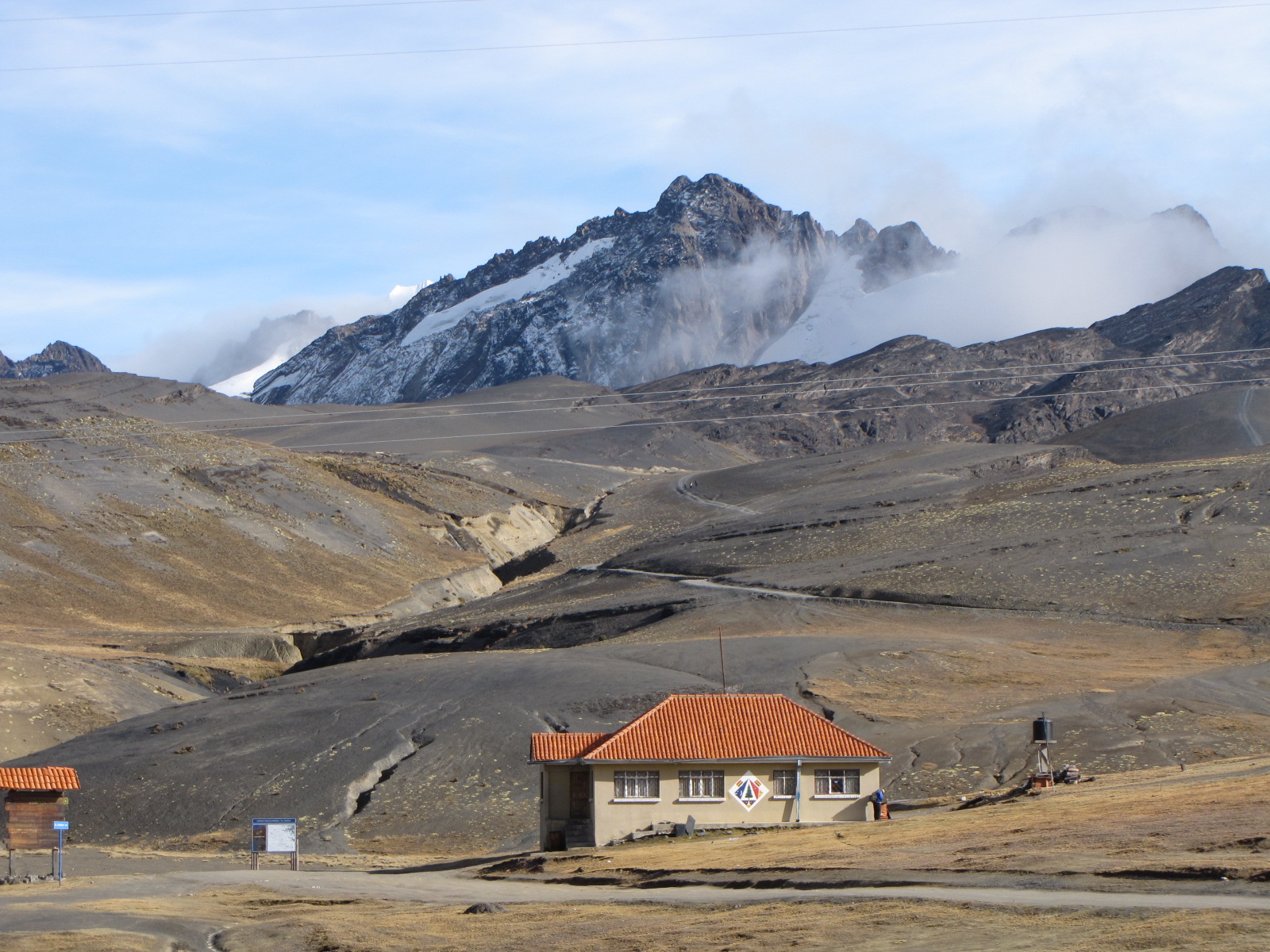
The bus ride provided many spectacular views of Lake Titicaca and the nearby mountain ranges as we weaved our way up the highway, and then the totally unexpected happened... we were told to get out of the bus. There was no warning that this would occur. No notice, nothing, nada,... except the Spanish driver saying something to a few people up front, and word slowly filtering it's way to the back of the bus where we were sitting. We grabbed our daypacks, and followed everyone out. As soon as the last passengers disembarked, the bus drove off onto a boat.
That's right, our bus was heading across the inlet and we were left stranded without any instructions on the wrong side of the waterway. That is, until someone found out that there's a passenger ferry further to the left, where each one of us had to buy a 1.50 Boliviano ticket to cross the river. Wasn't it nice of the bus ticket salesman and driver to not mention anything about a ferry crossing!
After lining up for a a ferry ticket, we boarded a motor boat, inhaled our annual dose of diesel fumes, and caught up to our waiting bus on the other side.
We ended up in La Paz and our hotel just before 6pm, which left us only an hour to find the Gravity Assisted office and sign up for tomorrow's biking excursion.
After signing our lives away, we proceeded to have dinner at a French Canadian restaurant. Apparently, Quebecois cuisine isn't very popular in La Paz as we had the whole place to ourselves on a Friday night. The food did not meet our homesick expectations but was decent nonetheless, and then just as got our bill, a couple, from all places, Gatineau, sat down across the room from us.
Review of Hotel La Cupula
One travel guidebook recommends "splurging" on a room at Hotel La Cúpula in Copacabana, Bolivia. So we did. Oh, we certainly did... $36 USD got us a triple room with our own private bathroom. Yes, you read that right, splurging means dropping only 36 bucks for a private room in a hostel / hotel overlooking the beach.
Except for a loose ventilation unit in the wall, there was nothing to complain about during our stay at La Cupula so I won't write much. Here are some photos of the hostel's exterior:
and our room (sorry about the mess)...
A note about the restaurant... be sure to reserve a table for dinner or you might not be able to get in. The nice thing about this hostel is its large property with its strategically placed hammocks and lawn chairs, and there is even a volleyball court, if you're so inclined to join in on a game with your fellow guests.
Although Copacabana was a bit of a disappointment, Hotel La Cupula definitely was not and it would definitely be worthwhile place to stay for an extra few days if you just want to lie back in a hammock and relax.
If you found this unbiased review helpful, please click on one of the interesting Google advertising links on this blog to help me out. Thanks.
Subscribe to:
Posts (Atom)
Popular Posts
-
In the last post , we had a glimpse of VIA Rail's Economy Class offering on The Canadian . So is it worth paying extra for VIA's S...
-
Upon boarding the train, I was informally offered an upgrade to a private cabin by a VIA Rail crew member. Of course I'll take it! Afte...
-
Travelling in economy class on VIA Rail's The Canadian train provides you access to the Economy Car and Skyline Car. Here are some pics...
-
Christmas is a festive time of year and in keeping with the spirit of the season, many of the windows in Downtown Victoria turn into magical...
-
One of the perks of travelling in the Sleeper Plus Class on VIA Rail's The Canadian train is the food. Delicious meals are prepared on...
-
When travelling in the Sleeper Plus Class of VIA Rail's The Canadian , not only do you have access to the Economy Class ' panoramic...
-
May 30 (Day 12) The day begins with an early taxi ride to the train station. There were some concerns earlier in the week when we came ...
-
Words can not describe Lake O'Hara but perhaps Kathy & Craig Copeland, the authors of Don't Waste Your Time in the Canadian Rock...
-
After grabbing a bite to eat at the Plain of Six Glaciers Tea House , it was time to get back to business and start the hike up to Lake Agn...